


The tech innovations you need to know
Reliable testing at the speed of production
Across the F&B sector, manufacturers are increasingly bringing food safety decisions closer to the point of need. As pressure grows to maintain throughput, ensure compliance and minimise disruption, speed and reliability have become the most important factors in maintaining safe, efficient and profitable operations.
Whether assessing incoming raw materials, verifying allergen controls or determining if a shipment can be released, trusted decisions often need to be made immediately. Yet many testing processes still rely on laboratory analysis that can take hours or even days to return results.
The challenge is that delays carry consequences. Waiting for test results can create production bottlenecks, increase storage costs and disrupt supply chains. Grain handlers, processors and manufacturers may be forced to hold materials, postpone production schedules or delay product release while critical food safety decisions remain unresolved.
As production environments become increasingly complex, businesses are looking for ways to generate reliable information closer to where decisions are made. This reflects a broader shift across the food industry. While laboratory testing continues to play a vital role in food safety programmes, many operational decisions now take place in grain intake facilities, ports and manufacturing sites, where time-sensitive checks cannot always wait for samples to travel to a laboratory.
However, rapid testing only delivers value when manufacturers have confidence in the accuracy and reliability of the results. Validated methods and dependable performance in real-world environments are becoming increasingly important as businesses look to maintain compliance while operating at pace. Trusted on-site testing can help reduce risk, support regulatory requirements and enable manufacturers to make informed decisions without compromising food safety standards.
As testing moves closer to where decisions are made, many manufacturers are looking for ways to simplify workflows and manage multiple food safety concerns through a single process, without adding complexity.
“Manufacturers don’t just need faster results, they need results they can trust”
Szabolcs Papp, Romer Labs
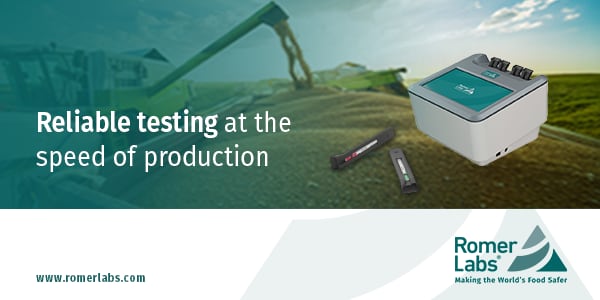
One example is Romer Labs’ AgraStrip Pro system with its AgraVision™ Pro reader. Rather than focusing on a single risk area, the system supports testing for mycotoxins, allergens and selected GMO applications through one platform. By enabling validated on-site testing across multiple categories, it helps manufacturers, processors and grain handlers access dependable results where operational decisions need to be made.
“Manufacturers don’t just need faster results, they need results they can trust. The industry is moving towards validated testing at the point of need, allowing businesses to make confident decisions without compromising compliance or food safety,” says Szabolcs Papp, Senior Global Communications Expert at Romer Labs.
The wider trend is clear: food safety testing is moving closer to the point of action. For manufacturers balancing compliance, efficiency and business performance, the ability to generate trusted results quickly is becoming an increasingly valuable part of today’s operations.
Tackling yield loss to unlock hidden value
When it comes to efficiency metrics, every percentage point counts. For food and drink manufacturers operating on tight margins, waste and yield loss remain some of the most significant yet difficult-to-address challenges from the factory floor to the boardroom. With raw material costs continuing to exert pressure across the sector, even small inefficiencies can have a substantial impact on profitability.
The challenge is that yield losses are rarely caused by a single issue. Instead, they often result from a combination of factors spanning production, planning, quality, supply chain operations and trade promotions. When data from these functions sits in separate systems, identifying the root cause becomes increasingly difficult.
“Value is lost between the point where raw materials enter a business and the point where finished product leaves it,” says Tom Foreman, industry and solution specialist for food and beverage at Infor. “Because processes are frequently siloed, manufacturers can struggle to see exactly where that loss is occurring.”
For many businesses, this lack of visibility means decisions are based on assumptions or dated reports rather than real-time operational insight. By the time issues are identified, the opportunity to prevent waste has already passed.
“Value is lost between the point where raw materials enter a business and the point where finished product leaves it”
Tom Foreman, Infor
Yet the potential rewards from improvement are significant. According to Foreman, a modest increase in yield can deliver significant value. “A 1% improvement in yield can be worth hundreds of thousands of pounds or euros to a manufacturer.”
The experience of Dutch cheese producer Amalthea illustrates the point. The manufacturer faced challenges because production, quality and planning data were spread across multiple systems, limiting its ability to understand how key variables were influencing output.
By connecting these previously isolated data sources through Infor’s industry specific AI capabilities, Velocity Suite, Amalthea gained visibility of milk yield at batch level. Machine learning analysis was then used to identify the factors influencing yield variation, enabling faster and more informed decision-making.
The result was for every 1% improvement in yield, it delivered a financial benefit of approximately €500,000.

While digital transformation projects have traditionally focused on reporting and retrospective analysis, advances in artificial intelligence (AI) are beginning to shift the emphasis towards prevention. AI-enabled systems can monitor multiple variables simultaneously and flag emerging risks before waste occurs, helping manufacturers intervene during production rather than afterwards.
This is particularly relevant in food manufacturing, where factors such as ingredient quality, temperature, processing conditions and production scheduling can all affect yield. By bringing operational data together and leveraging AI to uncover patterns that may otherwise go unnoticed, manufacturers are able to identify opportunities for improvement in real time.
As businesses continue to balance rising costs with sustainability ambitions, waste reduction and yield optimisation are becoming more than operational goals. They are strategic priorities with a direct impact on profitability, efficiency and long-term competitiveness.
Building visibility across food manufacturing operations
Food manufacturers are under growing pressure to protect margins while managing rising ingredient, energy and labour costs, increasing customer expectations and stringent compliance requirements. At the same time, they need complete control over ingredients, batches, recipes, shelf life, stock, production and quality. When this information is spread across multiple systems and spreadsheets, obtaining a reliable view of the business can become difficult and time-consuming.
For food manufacturers, this is more than an efficiency issue. Accurate, accessible information is essential for traceability, recall readiness, inventory management, production planning and meeting standards such as BRCGS.
Sage X3 is an enterprise resource planning platform that brings finance, purchasing, inventory, manufacturing, sales and operational information together within a single integrated system.
Vallestra specialises exclusively in Sage X3 and works closely with manufacturing and distribution businesses, with particular expertise in food and beverage. This combination of product knowledge and sector experience means Vallestra understands the operational challenges food manufacturers face, from batch and lot traceability, shelf-life management and recipe control through to production, costing, quality and BRCGS compliance.

“Greater visibility and control is one of the most common requirements among food manufacturers,” says Tom Mann, Director at Vallestra. “Businesses increasingly want a single, trusted view of what is happening across their operation.
“Senior management should be able to access current information quickly and understand exactly where the business is at that point in time, rather than relying on reports assembled from multiple systems and spreadsheets.”
An integrated Sage X3 ERP platform can deliver benefits across the operation. Improved stock visibility can help reduce excess inventory and waste, while batch and lot traceability makes it easier to track materials from supplier receipt, through production and ultimately to the finished goods customer.
“Businesses increasingly want a single, trusted view of what is happening across their operation”
Tom Mann, Vallestra
Shelf-life and expiry-date management can support better stock utilisation, while recipe and bill-of-material control helps maintain consistency across production. Stronger traceability and accessible records can also support BRCGS audits and recall readiness by providing clear evidence of how materials and finished products have moved through the business.
Successful digital transformation, however, is rarely about software alone.
Vallestra takes a partnership-led approach, working with customers to understand their processes, identify where complexity can be removed and configure Sage X3 to support both operational requirements and industry best practice. This spans discovery workshops, solution design, configuration, data migration, testing, training, go-live and ongoing support.
The relationship continues beyond implementation, helping customers refine processes, introduce new capabilities and ensure Sage X3 evolves alongside the business.
Artificial intelligence is also changing how businesses interact with ERP. With reliable operational and financial information held within a connected platform, AI can help automate routine tasks, identify exceptions and make information easier to access. Sage continues to invest in AI capabilities and intelligent agents designed to help users work more efficiently and gain faster insight from their data.
By combining Sage X3 with Vallestra’s specialist food manufacturing expertise and long-term partnership approach, businesses can build a connected, scalable platform that supports stronger traceability, BRCGS compliance, greater efficiency, better decisions and future growth.
The missing link in food safety: proving it’s fixed
A hygiene failure gets logged. A corrective action gets assigned. Six months later, an auditor asks for the evidence it was actually resolved. Can anyone find it?
Food manufacturers are generating more operational data than ever before, but data isn’t the same as accountability. For many food safety teams, some of the biggest risks still come down to proving that issues have been identified, addressed and prevented from happening again.
While audits remain a key milestone, leading food manufacturers recognise that compliance is only the starting point. The real test is whether failures get investigated, fixed and evidenced before they happen again.
Spreadsheets and notification-based systems struggle here. A corrective action can be flagged but overlooked.
mpro5 has been developed around a framework of ‘check, fix, prove, prevent and empower’, connecting operational checks, corrective actions, reporting and evidence all in the same place.
“Food safety isn’t just about completing a checklist. It’s about knowing that when an issue occurs, the corrective action has been completed, the evidence is there to prove it and you’ve reduced the risk of that issue happening again,” says Fred Whipp, CRO at mpro5.
For food manufacturers, corrective actions often present the greatest risk. While issues such as a failed hygiene inspection or a metal detection incident may be identified and recorded, demonstrating they have been fully resolved requires clear ownership and effective follow through. The ability to assign actions, capture photographic evidence and track completion is becoming increasingly important, particularly for manufacturers operating across multiple sites.
Alongside this, visibility is another growing priority. Food safety leaders are often responsible for managing compliance across multiple facilities while balancing the demands of audit preparation with daily operations. Real-time dashboards can provide oversight of performance, helping them to identify missed checks and address recurring problems before they escalate.
This level of visibility also supports a broader shift in how food safety is managed. Rather than being viewed as the responsibility of a single department, manufacturers are increasingly fostering a culture where operations, facilities and food safety teams share ownership of compliance, accountability and continuous improvement.

When DW Baking moved off paper and adopted mpro5, audit prep time dropped by 89%. What used to take two days of pulling files together is now a dashboard view, ready in minutes.
The scope is widening too. Manufacturers are increasingly folding employee safety into the same connected system, dust exposure monitoring, instant reporting of health and safety concerns, protecting both the products leaving the factory and the people working within it.
“Many manufacturers focus on the next audit but the real challenge is managing the risks you can’t see coming. Creating visibility around checks, corrective actions and recurring issues helps organisations move from compliance alone towards continuous improvement,” says Whipp.
“Creating visibility around checks, corrective actions and recurring issues helps organisations move from compliance alone towards continuous improvement”
Fred Whipp, mpro5
As regulatory requirements evolve and manufacturers face increasing scrutiny, the conversation is shifting from simply passing the next audit to building more resilient systems that support long-term operational performance.
mpro5 is offering a free, no-obligation analysis call to help you understand exactly where your frontline compliance stands today: the gaps costing you right now, the quick wins you can action immediately, and a clear path forward. Book your free food safety analysis via the link below.
Transforming production data into action
Food producers are operating in an environment of constant change. New product development cycles are accelerating and production teams must navigate increasingly complex quality, safety and compliance requirements.
Alongside these pressures, food producers are also dealing with rising costs, supply chain disruption and efficiency pressures. The challenge is not necessarily a lack of information – many businesses already have large volumes of operational data across their production environments. The difficulty lies in utilising that information to make faster, more informed decisions.
For many food producers, critical production data straddles machines, equipment, spreadsheets and business systems that have evolved independently over time. As a result, teams can struggle to see a complete picture of shop floor performance or understand the wider business impact of operational challenges.

“The challenge for many food producers is that operational technology and business systems have traditionally operated separately,” says Geoffrey Lloyd, regional delivery leader, Europe at InspireXT. “As a result, organisations can lack real-time visibility of what’s happening on the shop floor and how it affects wider business performance.”
As food producers increasingly explore AI, this disconnect between operational technology (OT) and information technology (IT) is becoming a growing focus across manufacturing. While machinery and production lines generate valuable operational insight, that information is not always connected – or “glued together”, says Lloyd – to the systems responsible for planning, forecasting, finance and supply chain management.
The consequences can extend beyond visibility alone. Production bottlenecks, downtime and capacity constraints can be harder to identify and address quickly, while teams often have limited access to real-time information about production progress. Many businesses also continue to rely on manual reporting processes that can delay decision-making and reduce accuracy and operational agility.
By bringing operational and business data together, organisations can create a better understanding of how production performance influences wider commercial outcomes.
InspireXT’s Connected Shopfloor Solution addresses this challenge, linking machine data, production activity and plant-level information with enterprise systems such as ERP, CRM and analytics platforms. The objective is to create a connected environment where production and business teams are working from the same information.
“Solutions that were once only available to the largest organisations are now becoming more accessible to mid-sized food producers”
Geoffrey Lloyd, InspireXT
By integrating production data with planning and operational systems, food producers can gain earlier visibility of equipment performance, production status and emerging issues. This can support real-time production planning, optimise deployment of labour and assets, reduce the impact of downtime and improve oversight of quality, traceability and compliance requirements.
According to Lloyd, advances in cloud-based technology are also making these capabilities more accessible than they were in the past.
“There’s still a perception that implementing technology is a major undertaking that is expensive and difficult to justify,” he says. “But solutions that were once only available to the largest organisations are now becoming more accessible to mid-sized food producers.”
For food producers seeking to balance efficiency, resilience and profitability, the focus is increasingly shifting from collecting operational data to connecting it. The ability to link what is happening on the factory floor with broader business decision-making is becoming a key factor in building more responsive manufacturing operations.
Connecting the data behind every product decision
Food manufacturers are under pressure from every direction. New regulations, changing consumer expectations, ongoing cost challenges, supply chain disruption and faster innovation cycles all require businesses to make decisions quickly and confidently. Yet many organisations are still managing critical information across disconnected systems, spreadsheets, email chains and shared drives.
The challenge is that information often becomes fragmented as products move through the lifecycle, from sourcing ingredients and onboarding suppliers through to product development, compliance, packaging, specification management and commercialisation.
As a result, teams spend valuable time searching for information, validating data and manually updating records rather than focusing on innovation, risk management and business growth.
“Manufacturers often have the information they need, but it sits across multiple systems, emails and supplier networks,” says Bal Chand, European marketing manager at TraceGains.
“The opportunity is not simply to digitise processes but to remove weeks of manual effort from bringing products to market,”
This is why leading food manufacturers are shifting their focus from digitising individual processes to creating a connected digital thread across the product lifecycle. A digital thread ensures that information flows seamlessly between suppliers, procurement, quality, regulatory, packaging, R&D and commercial teams. Rather than working in silos, teams can access the same trusted data, understand the impact of changes earlier and make better decisions faster.
“The opportunity is not simply to digitise processes but to remove weeks of manual effort from bringing products to market”
Bal Chand, TraceGains
TraceGains is a source-to-shelf platform, bringing critical business data together in a single place. It brings together the processes that food manufacturers typically manage separately, including supplier onboarding and collaboration, ingredient and raw material management, specification management, compliance, product development, formulation, labelling and packaging management.
By providing a single source of truth, TraceGains helps quality, regulatory, procurement and R&D teams understand the impact of changes faster, reduce manual effort and make decisions with greater confidence.

When a supplier updates a specification, introduces a new ingredient or changes packaging details, those changes can be shared across quality, regulatory, procurement and product development workflows. When R&D teams reformulate a product, they can assess supplier, ingredient, packaging and compliance implications without rebuilding. The result is greater visibility, stronger collaboration and faster decision-making across the organisation.
As AI moves from experimentation to practical application, the quality and accessibility of data is becoming increasingly important. Whether organisations are looking to accelerate supplier reviews, identify formulation opportunities or surface insights faster, AI is only as effective as the information behind it. By creating a digital thread across critical workflows, TraceGains helps food manufacturers establish the trusted data foundation needed to support better decisions today – and future AI-driven innovation tomorrow.
As the industry continues to face increasing complexity, the most successful manufacturers will be those that can connect data, people and processes to act on information faster and with greater confidence.
TraceGains provides the digital foundation that connects suppliers, ingredients, products, packaging and compliance data through a digital thread from source to shelf. The result? Better visibility, faster decisions, stronger supplier collaboration, AI-readiness and the agility to bring products to market with confidence.